
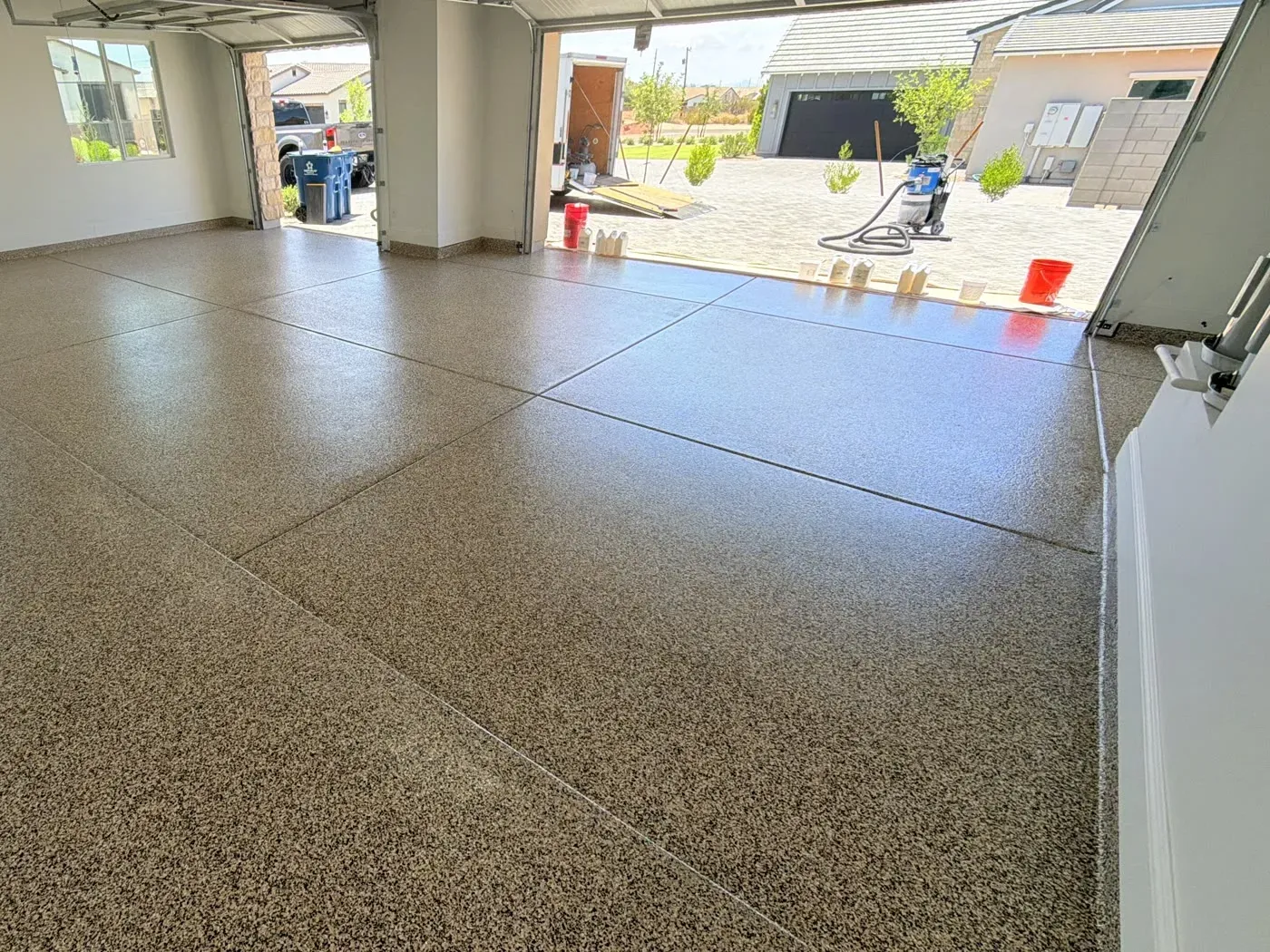
Garage floor coating cost
Starting at $2,000 for a two car garage, ground and coated over two days.
Most garage floors we look at start the same way: a gray slab with oil spots where the car sits, dark tire marks where it pulls in, and sometimes a kit coating from the last owner peeling off in two stripes. We grind that slab back to clean concrete, lay an epoxy base with flake broadcast into it, and finish with a polyaspartic clear top coat. The job takes two days, and the price comes off your square footage.
What a garage floor goes through in Arizona
A garage is the one room of the house nobody cools. Jayson was born and raised here, and he will tell you a slab in a shut garage on a summer afternoon runs hotter than the air around it. Then the car pulls in on hot tires and parks on the same two strips it parked on yesterday. A coating on that slab has to stay stuck through heat from both sides, in the same spots, every day.
What is already on the slab matters as much as the weather. Oil and antifreeze soak into concrete rather than sitting on top of it, and an old sealer or a stain leaves a film. A coating laid over any of those grips the film instead of the concrete, and when the film lets go, the coating goes with it. Monsoon storms add dust, and wet tires carry it into the grain of the slab.
Water also comes up from underneath. Moisture moving up through a slab pushes against anything sealed over the top of it, which shows up as blisters and patches that lift.
Hot tire pickup, and why coatings let go
Hot tire pickup is when a coating lifts off the slab under a car’s tires. Hot rubber softens the surface it sits on, and as the tire cools it grips harder and pulls. If the coating is thin, or the bond underneath it is weak, the coating comes up with the tire. That makes it a bond failure between the coating and the concrete, and thin coatings and weak surface prep are the usual causes. Grinding opens the concrete so the base coat keys into it, which is why every floor we do starts with the diamond grinder.
Those same two things, thickness and prep, are the difference between a kit and an installed floor. A kit is a thin coat over a hand prep, usually an acid etch, since nobody keeps a diamond grinder at home. An etch cleans the slab without opening it the way a grind does, and a thin coat has less to hold on with when a hot tire pulls. Some kit floors do fine in a garage that stays cool and sees one car. The garages that bake are where they give up first.
A coating losing its grip peels in the tire paths first, bubbles, or lifts at the edges. When the clear top coat sheets off and the flake stays down, the two coats never bonded to each other. A floor like that has to come off before a new one goes down, which is epoxy coating removal.
What hot tire pickup means for your floor in writing is in the written warranty, in its own words.
How we coat a garage floor
Jayson describes the job in one breath: “We blow it, we grind it with our diamond grinder. We'll grind it all, and then we'll clear it out, we'll vacuum, and then we prep the epoxy, we lay the epoxy down, we put the flake down, we let it hold for 24 hours, we come back, we scrape it, and then we put the clear coat or polyaspartic, and then that's the final.” Here is the same job one step at a time, with the reason for each.
- We blow the garage out, grind the whole slab with a diamond grinder and vacuum it, so the base coat lands on open concrete and not on oil, sealer or dust.
- We fill cracks before anything goes down, so a crack does not collect dirt under the coating or show through it. Crack filling is an add-on priced on your quote.
- Where the stem walls along the bottom of the garage walls are chipped or crumbling, we re-sack them, so the coating finishes against a sound edge.
- We lay the epoxy base coat and broadcast the flake into it while it is wet. Epoxy is what bonds to the concrete, and the flake locks into it.
- We leave the floor to hold for 24 hours. The base coat has to set up hard before anything goes over it, or the top coat traps what is still curing underneath and never bonds properly.
- We come back, scrape off the loose flake and roll on the polyaspartic clear coat, which seals the flake in and takes the sun.
Low spots and leveling we send out, so a slab that dips can still take a coating. The hold is why a garage floor is a two day install and never a one day job.
Epoxy vs polyaspartic on a garage floor
The epoxy vs polyaspartic question comes down to the top coat. Epoxy bonds to the concrete and carries the flake, so the base coat is epoxy. It is a poor thing to leave on top.
Epoxy all the way up
Straight epoxy ambers and chalks in sunlight.
Epoxy under a polyaspartic top coat
A polyaspartic top coat is UV stable and holds its color, so the clear coat that goes over the flake is polyaspartic rather than more epoxy.
Open the door on a west facing garage in the afternoon and the first few feet of floor sit in direct sun for hours. Polyaspartic goes on every floor we do, as standard.
There is one system and no cheaper version of it. In Jayson’s words, “Everything's gonna be premium.” What changes from one floor to the next is the finish, and the right one depends on how the garage gets used. Flake gives the floor texture underfoot and hides the small marks every slab has, so a full flake broadcast suits the garage that takes the most: two cars, a workbench, tools dropped on it. A light broadcast lets more of the base color show. Pure epoxy with no flake is one solid color, for a garage that is closer to a room. Metallic costs more than the others, because it brings in a second installer. Look at the flake colors in daylight before the quote visit, since a blend reads differently under garage lights.
What it costs and what to expect
We price by the square foot, always. A bigger garage costs more, and so do crack filling, stem wall repair, a metallic finish, or an old coating that has to come off first. Jayson comes out, measures the slab and gives you the price in person, and you pick your blend and book the install date at the same visit. If you would rather spread the cost, financing is available through Affirm.
Two car garages start at $2,000.
Jayson is on every job, and the installers who start your floor are the ones who finish it. For those two days the garage is out of use, so the cars live in the driveway or on the street. Both coats smell while they cure, and kids and pets stay off the floor until it takes feet. You can walk on it 24 hours after we finish and park on it after 48 hours.
We coat garage floors in Peoria, Youngtown, El Mirage, Surprise and Litchfield Park, among other cities. A driveway or patio done at the same time goes on the same quote, priced by its own footage, like everything else we do.
Get your estimate
Tell us where the slab is and roughly how big. We come back with a blend, a system and a price.
Got it.
We have your request and will call you back on the number you gave us to set a time to come out and measure.
While you wait, the flake colors page has every blend we can put down.
How long does a garage floor coating take to install?
It is 24 hours of work across two days. The first day is the grind, the crack filling, the epoxy base coat and the flake. Then the floor holds for 24 hours so the base coat can set up hard. The second day we scrape off the loose flake and roll on the polyaspartic top coat. Putting the top coat on the same day as the base is the one shortcut we will not take. Once we pack up, the floor takes feet after 24 hours and the car after 48 hours.
When can I park on my new garage floor?
After 48 hours. The top coat feels dry well before that, but it keeps hardening underneath after it stops feeling tacky. A car is the heaviest thing the floor carries, and hot tires are the hardest thing it deals with, so the car waits until the coating has had its full time. Until then the car lives in the driveway or on the street. If you can plan the install around a weekend away, the wait costs you nothing.
Do you fix cracks before coating?
Yes. We fill cracks in house before the coating goes down, and it is priced as an add-on on your quote. A crack left open collects dirt and moisture under the coating and shows through it. We re-sack stem walls in house too, where the concrete along the bottom of the walls is chipped or crumbling. Low spots and leveling we send out, so a slab that dips is not a reason to go without a coating. Jayson looks at all of it at the quote visit.
Can you coat over my old epoxy floor?
No. A new coating is only as good as what it is stuck to, and an old coating that is peeling or bubbling has already let go of the concrete somewhere. Coating over it means the new floor grips the old one and comes up with it. We grind the old coating off first and coat the clean slab, which is epoxy coating removal. Whether a floor that is only peeling in one spot needs to come off completely is something Jayson decides when he sees it.
Is a coated garage floor slippery when wet?
Any smooth, glossy surface is slick with water on it, and a coated floor is no different. Flake gives the surface some texture, and a full broadcast gives it more than a light one. The usual way to add grip is a fine grit mixed into the top coat, which also makes the floor a little harder to mop. If the garage doubles as a gym, a laundry room or the dog’s way in, tell Jayson at the quote visit how the floor gets used.