
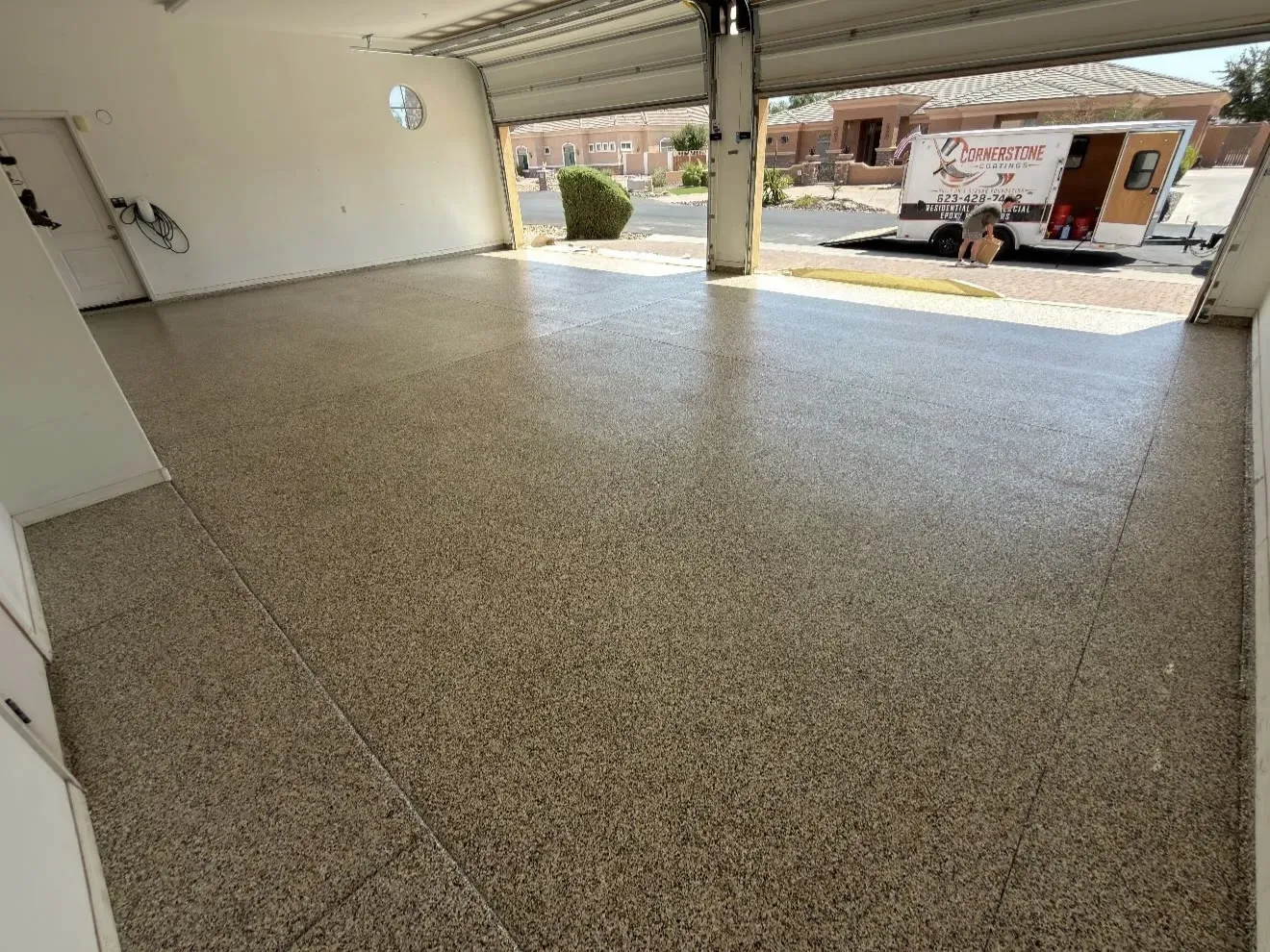
Driveway coating
The first concrete people see, ground clean and coated. Drive on it 48 hours later.
A bare concrete driveway shows everything. There is the dark patch where the car drips overnight, the black tire marks where it turns in, and a crack or two running out from the joints. We grind that slab back to clean concrete, fill the cracks, lay an epoxy base with flake broadcast into it, and finish with a polyaspartic clear top coat, which is the part of the system that faces the sun. The job takes two days, and the car comes back after 48 hours.
What a driveway goes through in Arizona
A driveway gets everything a garage floor gets, plus the sun. Jayson was born and raised here, and he will tell you concrete in full sun on a summer afternoon runs hotter than the air above it. The car comes home on tires that have been on hot asphalt and stops on the same two strips every day. Hot rubber softens the surface it sits on, and as the tire cools it grips and pulls. That is hot tire pickup, a bond failure between the coating and the concrete, and thin coatings and weak surface prep are the usual causes.
Then there are the drips. Oil and coolant land in the same spot every night and soak down into the concrete instead of sitting on top of it. A coating laid over an oil soaked patch grips the oil, not the concrete, and that patch is where it lets go first. An old sealer does the same thing across the whole slab, because it leaves a film for the coating to stick to instead of the concrete underneath.
Monsoon storms bring the rest. A driveway is poured with a slope so rain runs off toward the street, and where the slope flattens out, water sits and dust settles into it. Any glossy surface is slick with water on it, and that matters more on a slope you walk down to get the mail than on a flat garage floor.
What hot tire pickup means for your driveway in writing is in the written warranty, in its own words.
Cracks and control joints
Driveways crack. Concrete shrinks as it cures, grows and shrinks again with every hot day and cool night, and sits on soil that moves when a monsoon soaks it. The straight grooves cut across a driveway are control joints, put there so the slab cracks along the groove instead of wandering across the middle. A crack that runs somewhere else means the slab moved more than the joints allowed for.
We fill cracks in house before anything goes down, and crack filling is an add-on priced on your quote. A filled crack gives the coating a closed, level surface to go over, so dirt and water do not collect under it. A crack that is still moving can come back through a coating as a hairline, which is why Jayson looks at each one at the quote visit. Control joints are there to move, so how the joints are handled is one of the things to go over with him on the slab.
How we coat a driveway
- We blow the driveway off, grind the whole slab with a diamond grinder and vacuum it, so the base coat lands on open concrete and not on oil, sealer or dust.
- We fill cracks before the coating goes down, so they do not collect dirt and water under it. Crack filling is an add-on priced on your quote.
- We lay the epoxy base coat and broadcast the flake into it while it is wet. Epoxy is what bonds to the concrete, and the flake locks into it and gives the surface texture underfoot.
- We leave the driveway to hold for 24 hours, so the base coat sets up hard before anything goes over it.
- We come back, scrape off the loose flake and roll on the polyaspartic clear coat. Straight epoxy ambers and chalks in sunlight, and polyaspartic is UV stable, so the coat that faces the sun is polyaspartic.
- The car stays off the driveway for 48 hours, because the coating keeps hardening after it feels dry and a hot tire is the hardest thing it deals with.
The 24 hour hold between the two coats is why a driveway is a two day install, the same as a garage floor.
What it costs and what to expect
We price by the square foot, always. A longer driveway costs more, and so does crack filling or an old coating that has to come off first. Jayson comes out, measures the driveway and gives you the price in person, and you pick your blend and book the install date at the same visit. If you would rather spread the cost, financing is available through Affirm. A patio, the walkway to the front door or an RV pad beside the house can go on the same quote, each priced by its own footage, like everything else we do.
Jayson is on every job, and the installers who start your floor are the ones who finish it. For those two days the driveway is out of use. If the only way out of your garage is across the driveway, a car left in the garage stays there until the driveway takes tires, so plan where the car you need will sleep. You can walk on the driveway 24 hours after we finish and drive on it after 48 hours.
Get your estimate
Tell us where the slab is and roughly how big. We come back with a blend, a system and a price.
Got it.
We have your request and will call you back on the number you gave us to set a time to come out and measure.
While you wait, the flake colors page has every blend we can put down.
How long before I can drive on a coated driveway?
After 48 hours. You can walk on it after 24 hours, and the top coat feels dry well before the car can come back, but it keeps hardening underneath after it stops feeling tacky. A hot tire is the hardest thing a driveway coating deals with, so the car waits until the coating has had its full time. Until then the car lives on the street. If your garage opens only onto the driveway, anything parked inside stays there for those two days, so move the car you need out before we start.
Do you coat over cracks in a driveway?
Not over open ones. We fill cracks in house before the coating goes down, and crack filling is an add-on priced on your quote. An open crack under a coating collects dirt and water and shows through as a line. A filled crack gives the coating a closed, level surface to go over. Cracks are not a reason to skip coating a driveway, since most driveways have a few. Jayson looks at each one at the quote visit, along with the control joints, the straight grooves cut across the slab so it cracks where it is meant to.
Will old oil stains come through the coating?
Oil is a bond problem before it is a color problem. Oil soaks into concrete, and a coating laid over an oil soaked patch grips the oil instead of the slab, so that patch is where it lets go. The diamond grind opens the slab and takes off what sits in the top of it, and the base coat goes down on open concrete. A stain that has soaked deep is something Jayson looks at on the slab before he prices the job. Once the driveway is coated, new drips sit on the top coat and wipe up instead of soaking in.
Is a coated driveway slippery when it rains?
Any smooth, glossy surface is slick with water on it, and a coated driveway is no different. The slope matters too: a driveway is poured to shed water toward the street, and you walk down that slope to get the mail. Flake gives the surface some texture, and a full broadcast gives it more than a light one. The usual way to add grip is a fine grit mixed into the top coat, which also makes the surface a little harder to hose off. Tell Jayson at the quote visit who walks on the driveway and how often it gets wet.
Do I need HOA approval to coat my driveway?
It depends on your HOA. If it reviews exterior changes, a coated driveway may need its approval before the work starts, since the driveway is the part of the house everyone walks past. Where the rules cover color, the blend is what the HOA will look at, so get its rules before the quote visit and have them on hand. You pick the blend at that visit, and it helps to know what the HOA allows before you choose. Look at the flake colors in daylight, the way the neighbors will see them.